

What is Self-Advocacy?
Self-advocacy is expressing yourself to meet your needs. This is a critical social skill for kids and teens to build because it helps them in all areas of their lives, from academics, social interactions and relationships. The ability to self-advocate is a skill that can help a confident teenager grow into a confident and successful adult.
What is the Importance of Self-Advocacy?
Self-advocacy is crucial for children and teens because it’s important to be able to voice their needs and stand up for themselves. Being able to self-advocate helps children and teens work through life challenges and succeed in meeting their goals. Instead of simply relying on others to solve their problems, we can teach students to be their own problem-solvers with self-advocacy. This is a skill that is of critical importance in creating a sense of empowerment and self-worth that can carry on through adulthood.
What Self-Advocacy Looks Like
Self-advocacy can be different depending on the situation or scenario. These are a few real-life examples that children and teens might experience in their daily lives:
- Asking a question in class when you don’t understand something.
- Being willing to share your opinion, even if it may differ from the group
- Asking for help when you find a task challenging or frustrating
- Expressing how you truly feel to both friends and family
- Advocating for yourself when you feel you are being treated unkindly
- Saying no when a task makes you feel uncomfortable or unsafe
- Speaking up and trying to solve problems when you have an issue
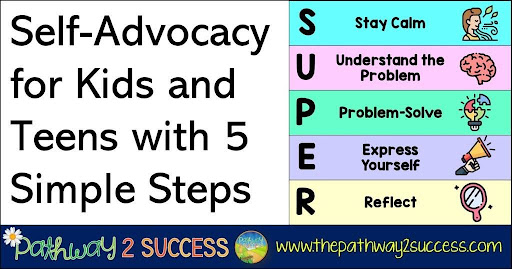
Self-advocacy skills can be taught, just like any other academic skill. As a student strengthens their self-advocacy skills, they will also begin to foster a sense of independence and build their self-confidence. An easy way to begin teaching self-advocacy is with the acronym SUPER. Each letter in the word SUPER matches with a step in the growth of self-advocacy skills.
Step 1: Stay Calm
The first step in self-advocacy is making sure to stay calm. You cannot properly solve problems if your emotions are not at a stable level. Breathing exercises like “Cookie Breathing or Take-Five Breathing can be used to regulate your breathing. Regulated breathing sends a message to your body’s nervous system that you are safe and that everything is under control.
In addition to breathing exercises, simple declarations of positive affirmation can be a good starting point in building self-advocacy. Some such phrases are “I’ve got this,” or “Let’s take this one step at a time.” It really comes down to finding a phrase that feels right to you.
Step 2: Understand the Problem
Self-advocacy at its core is problem-solving! You must understand the issue and the challenges that have been brought about by a problematic situation before you can seek a solution to it. You can start by posing the following questions to yourself:
- What is the issue that I am currently dealing with?
- How big is this problem from 1-5?
- What do I need to reach my goal in the moment?
- What is preventing me from accomplishing my goals?
With a deeper understanding of what you need, what you want, and what is “stopping” you, you will find yourself better equipped to problem-solve and get your needs met.
Step 3: Problem-Solve
After you have identified what the problem is, you can begin to problem-solve solutions to work through it. Every problem is different, and you will need to consider all the situational variables that may affect your outcome. The more you work toward solving issues as they arise, the better equipped you will become at identifying the best course of action for a given situation based on your needs and the consequences of your actions.
Step 4: Express Yourself
The ability to express yourself shows that you understand what your personal needs are. Understanding both your physical needs and emotional status is key to being able to express yourself. When expressing yourself, remember to use language that is direct and respectful to best express your needs. It is also important to remember to listen ,as the feedback you receive may help you to understand where the other person is coming from and aid you in coming to a resolution that will be accepted by all parties involved.
Step 5: Reflect
Once a situation has been resolved, it is important to take a moment to understand what went well and what you could improve in future situations. The simple act of reflecting on a situation will help to develop your self-advocacy skills, build up your confidence, and strengthen independence.
References:
Pathways 2 Success. (2024). Self-Advocacy for Kids and Teens with 5 Simple Steps. https://www.thepathway2success.com/self-advocacy-for-kids-and-teens-with-5-simple-steps/.
Pelham, Victoria. (2023). Five Deep Breathing Exercises for Kids and Teens Cedars Sinai. https://www.cedars-sinai.org/blog/five-deep-breathing-exercises-for-kids-and-teens.html.
Join Our Mission Today
Provide opportunities to get involved through youth leadership opportunities, advocacy, and engagement programs.